


| Issue |
Cah. Agric.
Volume 35, 2026
Resilience of semi-arid rural socio-environmental systems - Crossed points of view from Brazil and Africa / Résilience des systèmes socio-environnementaux ruraux semi-arides - Regards croisés Brésil et Afrique. Coordonnateurs : Julien Burte, Eduardo SPR Martins, Marcel Kuper, Sami Bouarfa, Jean-Yves Jamin
|
|
|---|---|---|
| Article Number | 8 | |
| Number of page(s) | 8 | |
| DOI | https://doi.org/10.1051/cagri/2026005 | |
| Published online | 6 avril 2026 | |
Article de recherche / Research Article
Facing water scarcity: A critical analysis of resilience and vulnerability of irrigation systems in Ceará, Brazil
Faire face à la pénurie d’eau. Analyse critique de la résilience et de la vulnérabilité des systèmes d’irrigation au Ceará, Brésil
1
CIRAD, UMR G-EAU, F-34398 Montpellier, France
2
G-EAU, Université de Montpellier, AgroParisTech, BRGM, CIRAD, INRAE, IRD, Institut Agro, Montpellier, France
3
IRD, UMR G-EAU, Montpellier, France
4
FUNCEME – Foundation Cearense for Meteorology and Water Resources, Fortaleza, Brazil
5
CEPAS/Universidade Federal do Ceará, Fortaleza, Brazil
* Corresponding author: Cette adresse e-mail est protégée contre les robots spammeurs. Vous devez activer le JavaScript pour la visualiser.
Abstract
This article examines how two irrigation schemes in Ceará, Brazil, coped with severe water scarcity between 2012 and 2018. Based on qualitative research, the analysis focuses on two schemes: one composed of smallholders and the other primarily occupied by agribusiness, both reliant on the Banabuiú reservoir, which nearly dried up. Findings show that differentiated forms of resilience emerge from socially constructed vulnerabilities and uneven access to resources. Political and institutional decisions promote irrigation as a development strategy, increasing water demand, framed by narratives of modern irrigation. These narratives legitimise certain strategic choices and categories of producers, shaping who is able to act and their capacity to respond to scarcity. Together, these processes influence which forms of resilience are possible, for whom, and at what scale.
Résumé
Cet article examine comment deux systèmes d’irrigation du Ceará, au Brésil, ont fait face à une grave pénurie d’eau entre 2012 et 2018. Sur la base d’une recherche qualitative, l’analyse se concentre sur deux périmètres : l’un composé de petits exploitants et l’autre principalement occupé par l’agro-industrie, tous deux dépendants du réservoir de Banabuiú proche de l'assèchement. Les résultats montrent que des formes différenciées de résilience émergent de vulnérabilités socialement construites et d’un accès inégal aux ressources. Les décisions politiques et institutionnelles promeuvent l’irrigation comme stratégie de développement, accroissant la demande en eau, dans le cadre de récits de l’irrigation moderne. Ces récits légitiment certains choix stratégiques et certaines catégories de producteurs, façonnant qui est en mesure d’agir et sa capacité à répondre à la pénurie. Ensemble, ces processus influencent les formes de résilience possibles, pour qui et à quelle échelle.
Key words: irrigated schemes / drought / resilience / vulnerability / Ceará
Mots clés : périmètres irrigués / sécheresse / résilience / vulnérabilité / Ceará
© E.D. Henriquez et al., Hosted by EDP Sciences, 2026
 This is an Open Access article distributed under the terms of the Creative Commons Attribution License CC-BY-NC (https://creativecommons.org/licenses/by-nc/4.0), which permits unrestricted use, distribution, and reproduction in any medium, except for commercial purposes, provided the original work is properly cited.
1 Introduction
The state of Ceará is located in the semi-arid region of Northeast Brazil, characterised by highly variable rainfall (200–1000 mm/year). Recurrent droughts have spurred the construction of numerous large public dams, many initially planned to supply public irrigation schemes managed by the National Department for Drought Works (DNOCS). This study focuses on two schemes: the Morada Nova Irrigation Scheme (PIMN), inaugurated in 1968, and the Tabuleiros de Russas Irrigation Scheme (DISTAR), launched in the early 2000s. Both were designed to be supplied by the Banabuiú dam—the third largest in Ceará, with 1.53 bn m3 capacity. As nearby urban populations grew, urban water supply was added to the initial irrigation function of the reservoir, which became the primary source of water for these populations.
A prolonged drought between 2012 and 2018 led to the collapse of the Banabuiú dam and the prohibition of its use for irrigation in both schemes. Despite this restriction, some productive continuity was observed. Water scarcity is a recurrent challenge for farmers in semi-arid regions, triggering diverse responses across spatial and social scales (Molle, 2008). The impact of extreme climatic events such as drought results from the interaction between the hazard and the sensitivity of a system (Benton et al., 2012; Rey et al., 2017). Resilience has long been used to analyse agricultural systems capacity to cope with disturbances such as drought (Urruty et al., 2016). Initially developed in ecology (Holling, 1973) and later extended to socio-ecological systems (Adger, 2000), the concept evolved from an output-oriented understanding towards a process-based perspective (Manyena, 2006). Among multiple definitions, the IPCC (2022) defines resilience as the capacity of social, economic and ecological systems to absorb disturbances, adapt and continue functioning while preserving core structures.
Widely framed as a positive attribute (IPCC, 2022), resilience carries a strong normative dimension (Urruty et al., 2016) that often obscures issues of agency and power in social systems (Olsson et al., 2015). Critics argue that by emphasising preexisting capacities, resilience risks to obscure the root causes of vulnerability (McDonnell, 2020). Resilience is neither innate nor evenly distributed; it is shaped by social structures that produce vulnerability and reflects structural power asymmetries (Harrison and Chiroro, 2017; March and Swyngedouw, 2022; McDonnell, 2020). Vulnerability should not be understood as a lack of resilience, but as the social, economic and political conditions that render people susceptible to harm from disruptive environmental change (Methmann and Oels, 2013), thereby shaping individual and collective resilience capacities.
From a political ecology perspective, this article examines how vulnerability to water scarcity is socially constructed in irrigation schemes, and how this determines which forms of resilience become possible, for whom, and at what scale. It does so by analysing who is able to mobilise adaptive strategies, under which narratives and legitimacies, and through which individual or collective practices.
The results highlight that the capacity of individuals and groups to respond to water scarcity, namely resilience, cannot be understood as purely intrinsic or spontaneous capacities and responses, but as outcomes of socially constructed vulnerability shaped by institutional action, legitimising narratives and unequal material conditions. The study contributes to critical scholarship on resilience in the region, where coping with water scarcity has largely focused on smallholder farming (Lira, 2016; Mendes et al., 2022) or − in the case of irrigated agriculture − on impacts and adaptation measures (Alves et al., 2022; Rey et al., 2017),without exploring the social processes shaping impact severity and vulnerability.
2 Methodology
2.1 Study cases
Since the early 20th century, DNOCS has played a central role in dam construction across Brazil’s semi-arid Northeast as a response to drought. From the outset, dams were conceived to sustain agriculture in the absence of rainfall and, from the 1950s onwards, became associated with irrigation schemes as a strategy for regional development. In Ceará, between the 1970s and 2000s, 17 public irrigation schemes were executed, each coupled to a reservoir (Carvalho et al., 2019). DNOCS oversaw the entire process, from planning to system management and settler supervision. Several schemes were concentrated in the Jaguaribe basin, which covers 49% of Ceará’s territory. The Banabuiú dam, completed in 1966, was later linked to two of these projects: PIMN and DISTAR.
In 1992, Ceará began implementing a new decentralised, integrated and participatory water management policy, establishing intersectoral river basin committees (RBCs). Since the 2002, the RBC of Banabuiú (RBC-B) plays an active role in deciding Banabuiú Dam releases, based on technical proposals prepared by the state. Both irrigation schemes participate in the RBC-B alongside other water users, public institutions and civil society.
2.1.1 Morada nova irrigation scheme - PIMN
The PIMN, in the municipality of Morada Nova, covered 10,849 ha (DNOCS, 2020), of which 4,085 ha were irrigated. Conceived as both a productive and social project, farming families were selected according to specific criteria (age, number of children, etc.; see Sousa, 2005) and allocated a residential plot and 5 ha for cultivation. The scheme was expected to serve as a regional model of advanced agriculture. Prioritised by DNOCS, rice became highly profitable in the 1980s and 1990s, with major impacts on the regional economy. A diversion weir downstream of the Banabuiú reservoir feeds a gravity-fed canal system that supplies plots irrigated by furrows and flooding.
2.1.2 Tabuleiros de Russas Irrigation Scheme - DISTAR
From the late 1980s, DNOCS developed a new irrigation project supplied by the Banabuiú dam: DISTAR, in the municipality of Russas. Delayed by administrative and financial constraints, the first phase of the scheme was officially inaugurated in 2004 with 10,761 ha for production. Yet it experienced a very low occupancy during its first decade, postponing the second phase until 2013. Unlike PIMN, DISTAR was primarily oriented towards agro-industry. 47% of the irrigable land was allocated to this sector in its first phase, while the remainder was shared between smallholders (39%), technicians (10%) and agronomists (5%). As with PIMN, small producers were expected to benefit from technology transfer by learning from large-scale producers. However, DISTAR prioritised agro-industrial production to ensure the project’s financial viability and was conceived as a hub for technological diffusion and economic growth.
DISTAR was initially supplied with water from the Banabuiú River through the Curral Velho reservoir and further conveyed to the scheme by a canal. Water would then be pressurized at the farm level, metered, and applied through drip and sprinkler irrigation systems.
2.2 Data and tools
The study draws on broader research conducted between 2022 and 2024 using a qualitative approach. A total of 76 in-depth and semi-structured interviews were carried out with key actors in water governance in Ceará, including public officials, representatives of social organisations and water users. Fieldwork also involved participant observation at relevant events, such as river basin committee meetings, recorded through ethnographic methods. Interviews were transcribed and, together with field notes, analysed through content coding, categorisation and thematic interpretation. The analysis was complemented by a review of grey literature. PIMN and DISTAR were selected as case studies as they are the two public irrigation schemes originally planned to be supplied by the Banabuiú reservoir, one of the most affected by the prolonged drought in the state.
The study is based on broader research (2022–2024) using an emergent qualitative design (Valles, 1997). Data came from participant observation in key events (committee meetings and others), fieldnotes, and 76 interviews (in-depth and semi-structured) with main water-governance actors (public officials, civil society, and users). Flexible guides focused on actor and irrigation-scheme trajectories, covering project start, drought experience, actions taken, and current conditions, with emphasis on water management. Interviews were transcribed and, with fieldnotes, analysed through content analysis with coding and category building. Following an inductive approach, categories were data-driven and aligned with research questions: social construction of vulnerability, adaptive inequalities, strategies and practices, and legitimizing narratives. Data were complemented with grey-literature review. PIMN and DISTAR were chosen as cases because they are the two public irrigation schemes originally planned to be supplied by the Banabuiú dam, one of the most drought-affected in Ceará.
2.3 Irrigated schemes facing scarcity
Banabuiú dam was stressed in the early 2000s, affecting PIMN partially, yet the later drought differed. Water continued to be released from the reservoir between 2012 and 2014 (8.1 m3/s on average), mainly for irrigation in both schemes. This was decided in participatory meetings, based on state technical proposals, in which PIMN and DISTAR representatives played a key role in advocating for continued releases. The RBC-B was led at that time by actors from Morada Nova, who supported generous releases, while DISTAR remained less influential at that time. In July 2015, with reservoir storage at 1.37%, the system collapsed and water use was restricted to human consumption, as mandated by law. With supply to irrigation discontinued until 2024, both schemes had to adapt their practices to the drought.
2.4 DISTAR: A paradoxical success
2.4.1 New water sources for a new modern project
Although initially a DNOCS project, DISTAR was incorporated into Ceará’s political and economic strategy to promote the Jaguaribe region as a hub for agro-industrial expansion. The project’s operational launch coincided with the 2001 drought, raising concerns about its supply among state authorities. A solution was found in the Castanhão reservoir—the largest in Ceará—which began operating in 2002. Using the inter-basin transfer known as the Eixão that connects the Castanhão to the capital, Fortaleza, the State Secretariat for Water Resources (SRH) decided to supply DISTAR with water from this dam (Fig. 1). The Curral Velho reservoir, became a strategic buffer reservoir, receiving water via the Eixão and supplying both the capital’s aqueduct and DISTAR’s intake canal. Between 2004 and 2014, DISTAR was thus supplied by both Banabuiú and Castanhão. As the contribution of Banabuiú dam gradually declined, until its collapse in 2015, DISTAR came to rely exclusively on the larger Castanhão.
Supplying DISTAR from Castanhão was not part of the project’s original design but aligned with a broader political-economic agenda promoted by the Ceará state government. Since the 1990s, successive administrations had implemented fiscal incentives and credit lines from the Banco do Nordeste to attract investment and foster agribusiness, particularly export-oriented fruit production (Cavalcante, 2023). Exports expanded during the 90s, reinforced by the creation of the Secretariat for Irrigated Agriculture in 1999 and the opening of the Pecém Port in 2002. Given these efforts, the state government could not risk disappointing newly attracted firms with an empty irrigation canal.
The agro-industrial sector consolidated its position as a politically influential actor within the state. This is reflected in the setting up of a specialised agribusiness body under the Secretariat for Economic Development (SDE), while family farming and agroecology fall under the Secretariat for Agricultural Development—two secretariats operating in parallel (Sabourin, 2014). Agro-industrial firms are also well organised politically through the Federation of Agriculture of Ceará (FAEC), which maintains close ties with the SDE and holds a seat on the State Water Resources Council (CONERH), the highest intersectoral water governance body. Several firms operating in DISTAR are FAEC members.
In policy and sectoral discourse, DISTAR is portrayed as the most modern irrigation scheme in Ceará, particularly due to its monitoring and irrigation technologies, promoted as the modern way to irrigate in semi-arid regions. DISTAR also played a key role in debates on water pricing. Equipped with on-farm water meters, it set a precedent in the 2000s as the first irrigation scheme to implement volumetric charging, a highly contested measure at the time. This reinforced its image as an innovative, forward-looking project aligned with best-practice water irrigation: efficiency, monitoring water use at farm level, advanced technology, reducing losses through lined canals, generating employment, and contributing to economic growth.
Here it is already considered a very modern project, first because of the water distribution, because it is not collective. Projects where distribution is collective are a problem, even when it comes to applying sanctions, right? (DISTAR actor).
So, these [irrigated schemes] are more modern, because of the technology, the automated floodgates [ . . .] We understand that this is the best way to manage water” (State Actor).
As of 2024, DISTAR primarily cultivates permanent fruit crops—banana (24%), guava (12%), coconut (12%) and jujube (10%)—alongside forage crops (10%). Production is dominated by around five large agro-industrial firms, including one with international capital, operating 200–300 ha each, while smallholders manage roughly 3 ha each.
Receiving water solely from the Castanhão Reservoir, DISTAR was integrated into the Jaguaribe basin and joined the larger Baixo Jaguaribe River Basin Committee. Its leaders became key actors in the state’s participatory water governance system, heading this committee as well as the Forum of River Basin Committees of Ceará, which confers a seat in the CONERH and enables participation in national and international events. DISTAR has thus emerged as a central actor in both agro-industry and water governance and is now widely touted as a successful project.
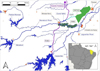 |
Fig. 1 Location of PIMN and DISTAR. Emplacement de PIMN et DISTAR. |
2.4.2 A still ongoing project?
Despite DISTAR’s apparent success, effective project occupancy in 2024 did not exceed 34% of Phase 1 productive area, and full occupancy has never been achieved. In 2014, during the drought, combined releases from Banabuiú and Castanhão peaked at 4.9 m3/s, allowing DISTAR to operate at 60% capacity. Between 2015 and 2022, however, average flow fell to 1.42 m3/s, only supplied by Castanhão. DISTAR was therefore not immune to drought. The board imposed water quotas and limits on crop area by type. Some seasonal crops were prohibited, prioritising permanent fruit crops. Producers exceeding quotas faced sanctions. Water scarcity also reduced production quality, lowering market prices and profits, which especially impacted the smallest farmers (Almeida, 2022).
Indeed, impacts were uneven. While restrictions applied to both large and small producers, smallholders were disproportionately affected, with some abandoning production altogether. In contrast, large agro-industrial firms could better cope, often holding land elsewhere to diversify risk and accessing technologies to mitigate drought effects. For instance, Meri Pobo, a foreign-owned firm that started operations at the height of the drought, installed soil moisture sensors for precision irrigation.
The scheme remains bedeviled by acute social conflicts revolving around health risks posed by intensive agrochemical use, displacement of peasant families for construction (da Silva, 2024) and litigation by the Landless Workers’ Movement (MST) advocating for their resettlement. Many outsiders are indebted to DNOCS and leave their land fallow, awaiting better market conditions. The reallocation of plots is hindered by bureaucratic obstacles and political sensitivities, reducing DISTAR’s attractiveness to investors.
Nevertheless, continued water supply and DNOCS subsidies aim to preserve DISTAR’s image as a modern irrigation model—a key regional solution—secured by Castanhão and, theoretically, Banabuiú water, the latter still being featured in project promotional materials.
2.5 PIMN: The decline of a social project
2.5.1 An unexpected shift: from rice to shrimp
The 2015 water cut exacerbated longstanding productivity and organisational problems at PIMN. Initially, a single cooperative managed all settlers’ production alongside DNOCS. The scheme modernisation approach marginalised farmer participation, assuming smallholders lacked adequate skills. However, from the 1980s, DNOCS began transferring management to users. Producers felt overwhelmed by this process of so-called emancipation, while federal agents blamed them for indiscipline. This occurred amid poor public irrigation performance and increasingly liberal policies promoting market mechanisms and individual incentives (Queiroz et al., 1996).
The water shortages coincided with rising organisational tensions, prompting informal land liberalisation: plots were leased or sold irregularly, as settlers held only usufruct rights, creating opportunities for outside investors. Weakened institutionally, DNOCS lacked capacity and political will to intervene. Three additional cooperatives emerged under the original one. Producers reported being unprepared to manage these associations and soon faced overwhelming debts. Moreover, the cooperative’s failure to collect user fees further hindered infrastructure maintenance.
Despite these challenges, some plots found alternative water resources. In the previous drought in 2001, some producers had identified groundwater sources. By 2014, several farmers, often descendants of original settlers, drilled wells using personal savings or loans, formal and informal, particularly from family networks. Entrepreneurs from the neighbouring Baixo Jaguaribe region, leasing plots with groundwater access, built the first shrimp ponds. Observing their success, some local producers emulated this practice.
Shrimp ponds quickly proliferated in PIMN. As profits grew, smallholders expanded the activity. While some state agents questioned its environmental impacts and limited employment generation, for many shrimps farming now offered quick profits, improved quality of life, and hope, attracting neighbours’ curiosity and interest. However, pond construction requires substantial investment, including major modifications to plots, and carries high risk (e.g., power outages). These costs and risks render the activity inaccessible to many producers, leaving much of the production to individuals from outside the original community. However no official data exist on production or producer origins, due to weakened administration and informal land transactions. Groundwater availability also varies across the scheme, and many plots lack this alternative. Without funds to lease additional land or cover shrimp farming costs, many producers simply abandoned their plots.
2.5.2 Paying the price for the rice age?
Despite strong PIMN producer participation in water governance during the 90s, engagement declined sharply following the 2014 water cut. This reflected the weakening of organisational structures within the scheme. Without access to surface or groundwater, many producers ceased participating in cooperatives. Payments for scheme maintenance—to DNOCS and the cooperatives—declined, leaving cooperatives with unsustainable debts. Although cooperatives persisted formally, they gradually weakened; assets were liquidated to pay debts, and even cooperative leaders abandoned plots, losing interest in both the scheme and participation in the RBC-B. Some representatives deemed Committee meetings ineffective, alleging that reservoir decisions were predetermined by the state, and stopped attending. Initially, PIMN producers demanded solutions, but these were ignored, and canals remained dry.
Concurrently, PIMN suffered a loss of legitimacy within the RBC-B. Urban water supply actors gradually gained influence in the organisation, and irrigated agriculture lost the legitimacy it had previously held. Committee members and state agents partly blamed water scarcity on overuse, accusing PIMN of wasting water through flood irrigation.
Because the PIMN is known as the rice region, which is a crop grown by flooding! [ . . .] when you get there and say you can’t plant, there is resistance. Because it is flooding, it is archaic, it is too wasteful! (state actor).
Many PIMN producers internalised this critique and producers themselves found justifications for their lack of water access priority. Producers resigned themselves not only to the lack of water from Banabuiú but also to being deprived of water from the Eixão system, which paradoxically crosses PIMN’s diversion canal (Fig. 2), yet was never connected. PIMN is thus perceived as an outdated, inefficient project, seemingly deserving its water scarcity.
The human history changed. For example, some data: [PIMN] it’s an archaic perimeter in terms of technology, it dries out, and then it becomes difficult (Farmer).
Additionally, groundwater use led many members of the RBC-B—including state agents—to view PIMN producers as having successfully adapted, emphasizing their entrepreneurial capacity to discount the need for further measures.
 |
Fig. 2 Eixão Pipe crossing over PIMN Canal. Canalisation Eixão traversant au-dessus du canal du PIMN. |
3 Discussion
Analysing the resilience of irrigation systems and their producers requires questioning the processes that shape actors’ capacity to cope with events such as drought. The ways in which water scarcity and its impacts are addressed cannot be explained by actors’ intrinsic characteristics, but rather as the outcome of social processes that configure vulnerability (March and Swyngedouw, 2022).
The results show that, in both cases, producers and irrigation schemes followed trajectories that placed them in positions of variable vulnerability. These trajectories were shaped by a chain of interrelated processes. First, political and institutional decisions promoted irrigation as a development strategy, expanding water demand and producing vulnerability in the face of climate vagaries. These decisions simultaneously generate narratives of modern irrigation, through which access to water is legitimised for some actors while delegitimised for others.
Second, these differentiated legitimacies condition who is able to act, at both individual and collective levels. In practice, the capacity to respond to scarcity is unevenly distributed, depending on producers’ material resources and the degree of collective organisation within each scheme. Together, these processes define which forms of resilience become possible, for whom, and at what scale.
3.1 The promise of modern irrigation: differentiated social legitimacies in water access
PIMN and DISTAR emerged from studies conducted in the 1960s aimed at fostering economic productivity and regional development. Both projects embodied the idea that irrigated agriculture constitutes a development strategy for the semi-arid region, grounded in a continued pursuit of development and modernity (Quijano, 2000). Classifying these projects as modern or developed implies a linear vision of territorial evolution, in which areas deemed unproductive must be transformed into productive spaces, despite the questionable sustainability of such interventions.
If water scarcity in Banabuiú can be partly explained by low rainfall, the drought reflected a failure to curb releases in the first years of the drought, and also a degree of basin overbuilding (Molle, 2008). Persistent public policies and investments have produced structural vulnerabilities by generating sustained demand for large volumes of water in a context of very high hydrologic variability. This also created socio-economic dependency on irrigation projects as the primary development pathway in semi-arid territories, despite their costs and long-term unsustainability (Elias, 2005).
The paradigm of agricultural modernization is not only expressed in development policies but also shapes how producers are socially differentiated and positioned in terms of legitimacy (Harrison and Chiroro, 2017), for example regarding access to water. Although the official justification for supplying DISTAR but not PIMN via the Eixão was the limited capacity of the aqueduct, this was also a political decision, framed by a narrative dichotomy between the modern and the non-modern. Beyond its technical function, the Eixão symbolizes the state’s prioritization of agribusiness, reinforcing DISTAR’s modern status.
DISTAR embodies dominant conceptions of agriculture: efficient localized irrigation, private agribusiness actors seeking export markets, and financially responsible users who pay for water. In contrast, PIMN is presented as non-modern or outdated, and rice production—previously promoted by the state—now considered inefficient, wasteful, and obsolete. Prioritizing DISTAR over a less modern agriculture such as PIMN is not merely a technical decision, but a symbolic and political one. Notions of modernity and efficiency function as criteria for inclusion and exclusion (Boelens and Vos, 2012), and this distinction ultimately shapes the legitimacy of each system and its producers in claiming access to water.
While the modern–non-modern distinction has been widely examined (Zwarteveen and Boelens, 2014), the cases of PIMN and DISTAR show that show that this distinction does not function solely as an external narrative defining actors’ legitimacy. These categories are also unevenly internalised by producers themselves, shaping how they perceive their own legitimacy, their scope for action and their willingness to engage. In this way, responses to water scarcity are influenced by processes of subjectivation that mould agency and, ultimately, delimit the forms of resilience that become possible. This dynamic helps explain both the resignation of PIMN producers within participatory arenas such as the RBC-B, as well as the empowerment of DISTAR within Ceará’s participatory water governance system.
3.2 Unequal individual adaptations: what space for collective resilience?
In both cases, producers deployed individual adaptation strategies that shaped their resilience capacity. These strategies relied on unevenly distributed resources, primarily material and financial capital. Producers with greater economic means were able to implement more robust strategies, while others were effectively excluded. In PIMN, shrimp ponds were developed primarily by external actors, and few original residents were eventually to invest successfully. In DISTAR, large companies led technological adaptation, and smallholders were more heavily impacted. Thus, adaptation and resilience were individualised, reinforcing unequal distributions of vulnerability and risk (Zahnow et al., 2025).
Part of exercising power and agency to be resilient, also involves acting collectively (Harrison and Chiroro, 2017). Collective action, however, is not solely a matter of resource management (Cleaver, 2007). In PIMN, social disarticulation is evident, compounded by the entry of external producers. In DISTAR, although participation occurs at the basin level and coordination among large agribusinesses—particularly through associations such as FAEC—is stronger, the scheme still faces low quorum at assemblies, poor adherence to rules, and persistent disparities between companies and smallholders, including resettled families who lost previous community ties. The lack of organised collective action and social cohesion within these schemes limits systemic resilience, creating what can be understood as collective vulnerability (Sapountzaki, 2014).
This vulnerability—and consequently, the capacity to be resilient—is not intrinsic but emerges from social processes. The concept of modern agriculture incorporates an individualising logic—for example, by valuing individual water meters for billing or the entrepreneurial capacity of shrimp producers in PIMN. At the same time, public policies shaping these irrigation schemes were entirely externally driven, guided by a modernising logic that displaced local populations and destabilised social structures. In PIMN, families were resettled under a developmentalist framework that marginalised their knowledge and practices, while in DISTAR, the project dismantled existing community relations and resilience strategies (DSP, 2015). As a result, both programs struggled to develop effective collective management.
Without assuming that local management is intrinsically good (McDonnell, 2020), it is important to consider whether irrigation systems can be more than spatial aggregations of individuals, particularly given the socio-hydrological interdependencies inherent in shared water and infrastructure. Resilience strategies mobilised individually by those with the resources to adapt may mitigate impacts for some, but they do not guarantee a broader or fairer redistribution of those impacts (March and Swyngedouw, 2022).
4 Conclusion
When analysing how agricultural systems face water scarcity, the concept of resilience can be highly useful. However, an uncritical perspective risks shifting responsibility onto individuals (McDonnell, 2020) and obscuring the power relations and social processes that shape the resilience of groups and individuals (Harrison and Chiroro, 2017; March and Swyngedouw, 2022). A critical approach to resilience highlights that the capacity of actors and groups to cope with socio-natural challenges largely depends on broader political and social structures that shape different types of vulnerability (Methmann and Oels, 2013).
The analysis of PIMN and DISTAR schemes in Ceará revealed that exposure to water scarcity is largely the result of social and political decisions. These include: the production of over-demand in already water-stressed basins; the deployment of narratives (modern versus non-modern irrigation) that assign differentiated legitimacies to water uses and justify exclusion—particularly of smallholders deemed outdated; and the promotion of individualised adaptation strategies that rely on producers’ unequal material resources in the absence of collective risk-sharing mechanisms. Together, these processes delimit who is able to act, under which conditions, and what forms of resilience become possible. This individualisation of resilience is reinforced by the very policies that have weakened endogenous collective capacities within these irrigation territories. As a result, resilience tends to be individual and concentrated among actors with greater economic and political resources, while vulnerability is reproduced and unevenly distributed.
From a practical standpoint, promoting more equitable development within these irrigation systems—and future agricultural initiatives—requires public policies that support co-constructed resilience. This should build on existing local strengths, knowledge, and capacities, and reinforce intra-group social ties, enabling more collective and fairer responses to water scarcity. Approaches that emphasise living with the semi-arid (da Silva, 2007) could contribute to more local, endogenous development across both modern and non-modern irrigation projects.
Acknowledgments
This work was supported by Sertões project funded by the French Development Agency (AFD) and benefitted from the institutional support of CIRAD (Montpellier) and FUNCEME (Ceará Foundation for Meteorology & Water Resources). We acknowledge the contribution of the National Research and Development Agency (ANID), Chile, to the doctoral research. Additional financial support was provided by CAPES-COFECUB (grant no. 88887.711963/2022-00), and FUNCAP-FIT (grant no. 4920881/2018).
References
- Adger W. 2000. Social and ecological resilience: are they related? Prog Hum Geogr 24 (3): 347–364. https://doi.org/10.1191/030913200701540465. [Google Scholar]
- Almeida E. 2022. Estratégias de adaptação à seca: um estudo de caso em Tabuleiro de Russas. https://repositorio.ufc.br/bitstream/riufc/72457/3/2022_tcc_eblalmeida.pdf. [Google Scholar]
- Alves H, Jardim A, Júnior G, Souza C, Leite R, Silva G, et al. 2022. Uma abordagem sobre práticas agrícolas resilientes para maximização sustentável dos sistemas de produção no Semiárido brasileiro. Rev Bras Geogr Fís 15 (1): 373–392. https://doi.org/10.26848/rbgf.v15.1.p373-392. [Google Scholar]
- Benton T, Gallani B, Jones C, Lewis K, Tiffin R. 2012. Severe weather and UK food chain resilience. Global Food Security. https://www.foodsecurity.ac.uk/publications/severe-weather-uk-food-chain-resilience-detailed-appendix-synthesis-report.pdf. [Google Scholar]
- Boelens R, Vos J. 2012. The danger of naturalizing water policy concepts: Water productivity and efficiency discourses from field irrigation to virtual water trade. Agric Water Manag 108: 16–26. https://doi.org/10.1016/j.agwat.2011.06.013. [Google Scholar]
- Carvalho JM, Guerra B, Oliveira A, Neto F, &Segundo A. 2019. DNOCS: Desenvolvimento e gestão dos recursos hídricos no semiárido nordestino. Ed. DNOCS. Fortaleza, CE [Google Scholar]
- Cavalcante L. 2023. Entre fazendas e firmas: Agronegócio da fruticultura e concentração fundiária no Baixo Jaguaribe. Revista Campo-Território 18 (49): 216–240. https://doi.org/10.14393/RCT184967055. [Google Scholar]
- Cleaver F. 2007. Understanding agency in collective action. J Human Dev 8 (2): 223–244. https://doi.org/10.1080/14649880701371067. [Google Scholar]
- da Silva RMA. 2007. Entre o combate à seca e a convivência com o semi-árido: políticas públicas e transição paradigmática. Rev Econ Nordeste 38 (3): 466–485. https://doi.org/10.61673/ren.2007.539. [Google Scholar]
- da Silva FJC. 2024. Lagoa dos Cavalos e o Perímetro Irrigado de Tabuleiro de Russas: Tecendo memórias de re-existência. Universidade Estadual do Ceará. Limoeiro do Norte. [Google Scholar]
- DNOCS. 2020. Perímetro Irrigado Morada Nova. 50 Anos Irrigando o Desenvolvimento. Ed. RDS, Fortaleza, CE. [Google Scholar]
- DSP. Dossiê Perímetros Irrigados. [2025/07/16]. https://dossieperimetrosirrigados.wordpress.com/. [Google Scholar]
- Elias D. 2005. Territorialização do capital no espaço agrário cearense. GEOGRAFIA 30 (2): 223–239. https://www.periodicos.rc.biblioteca.unesp.br/index.php/ageteo/article/download/658/5033/36084. [Google Scholar]
- Harrison E, Chiroro C. 2017. Differentiated legitimacy, differentiated resilience: beyond the natural in ‘natural disasters’. J Peasant Stud 44 (5): 1022–1042. https://doi.org/10.1080/03066150.2016.1193011. [Google Scholar]
- Holling CS. 1973. Resilience and stability of ecological systems. Annu Rev Ecol Syst 4: 1–23. https://doi.org/10.1146/annurev.es.04.110173.000245. [CrossRef] [Google Scholar]
- IPCC. 2022. Contribution of Working Group II to the sixth assessment report of the intergovernmental panel on climate change. Summary for policymakers. In: Pörtner H, Roberts D, Poloczanska E, et al. eds. Climate change 2022: impacts, adaptation, and vulnerability. Cambridge (UK): University Press. https://doi.org/10.1146/annurev.es.04.110173.000245. [Google Scholar]
- Lira J. 2016. Resiliência da agricultura familiar no nordeste brasileiro. Fortaleza: Universidade Federal do Ceará. https://repositorio.ufc.br/bitstream/riufc/19395/1/2016_dis_jslira.pdf. [Google Scholar]
- Manyena SB. 2006. The concept of resilience revisited. Disasters 30 (4): 434–450. https://doi.org/10.1111/j.0361-3666.2006.00331.x. [Google Scholar]
- March H, Swyngedouw E. 2022. Resilience for all or for some? Reflections through the lens of urban political ecology. In: Ruiz-Mallén I, March H, Satorras M, eds. Urban resilience to the climate emergency. Cham: Springer International Publishing, pp. 3–19. https://doi.org/10.1007/978-3-031-07301-4_1. [Google Scholar]
- McDonnell S. 2020. Other dark sides of resilience: politics and power in community-based efforts to strengthen resilience. Anthropol Forum 30 (1–2): 55–72. https://doi.org/10.1080/00664677.2019.1647828. [Google Scholar]
- Mendes P, Almeida A, Litre G, Rodrigues Filho S, Saito C, Dávalos N, et al. 2022. Public policies and adaptation to climate change: three case studies in the Brazilian semi-arid region. Sustain Debate 13 (3): 209. https://doi.org/10.18472/SustDeb.v13n3.2022.46064. [Google Scholar]
- Methmann C, Oels A. 2013. Vulnerability. In: Death C, ed. Critical environmental politics. Routledge, 368 p. https://www.routledge.com/Critical-Environmental-Politics/Death/p/book/9780415631228. [Google Scholar]
- Molle F. 2008. Why enough is never enough: the societal determinants of river basin closure. Int J Water Resour Dev 24 (2): 217–226. https://doi.org/10.1080/07900620701723646. [Google Scholar]
- Olsson L, Jerneck A, Thoren H, Persson J, O’Byrne D. 2015. Why resilience is unappealing to social science: theoretical and empirical investigations of the scientific use of resilience. Sci Adv 1(4). https://doi.org/10.1126/sciadv.1400217. [Google Scholar]
- Queiroz C, Aragão P, Pakman E. 1996. Perímetros irrigados e modernização agrícola. Raízes (12): 15–32. https://doi.org/10.37370/raizes.1996.v.506. [Google Scholar]
- Quijano A. 2000. El fantasma del desarrollo en América Latina. Revista del CESLA (1): 38–55. https://bibliotekanauki.pl/articles/938091.pdf. [Google Scholar]
- Rey D, Holman IP, Knox J. 2017. Developing drought resilience in irrigated agriculture in the face of increasing water scarcity. Reg Environ Change 17 (5): 1527–1540. https://doi.org/10.1007/s10113-017-1116-6. [Google Scholar]
- Sabourin É. 2014. L’agriculture brésilienne en débat: évolutions récentes, controverses et politiques publiques. Problèmes d’Amérique latine 95 (4): 33–55. https://doi.org/10.3917/pal.095.0033. [Google Scholar]
- Sapountzaki K. 2014. “Resilience for All” and “Collective Resilience”: Are these planning objectives consistent with one another? In: Gasparini P, Manfredi G, Asprone D, eds. Resilience and sustainability in relation to natural disasters. Cham: Springer International Publishing, pp. 39–53. https://doi.org/10.1007/978-3-319-04316-6_4. [Google Scholar]
- Sousa EMdO. 2005. O « Novo Modelo de Irrigação » e os colonos de Morada Nova: Política para qual público? Fortaleza: Universidad Estadual do Ceará. https://www.uece.br/wp-content/uploads/sites/56/2019/12/elisangela_maria_de_oliveira_souza1.pdf. [Google Scholar]
- Urruty N, Tailliez-Lefebvre D, Huyghe C. 2016. Stability, robustness, vulnerability and resilience of agricultural systems. A review. Agron Sustain Dev 36 (1): 15. https://doi.org/10.1007/s13593-015-0347-5. [Google Scholar]
- Valles M. 1997. Técnicas cualitativas de investigación social: reflexión metodológica y práctica profesional. Madrid (Spain): Síntesis. http://www.isel.edu.ar/assets/it_valles%5B1%5D.pdf. [Google Scholar]
- Zahnow R, Yousefnia AR, Hassankhani M, Cheshmehzangi A. 2025. Climate change inequalities: A systematic review of disparities in access to mitigation and adaptation measures. Environ Sci& Policy 165: 104021. https://doi.org/10.1016/j.envsci.2025.104021. [Google Scholar]
- Zwarteveen M, Boelens R. 2014. Defining, researching and struggling for water justice: some conceptual building blocks for research and action. Water Int 39 (2): 143–158. https://doi.org/10.1080/02508060.2014.891168. [Google Scholar]
Citation de l’article : Henriquez E.D, Mitroi V, Molle F, Rabelo SL, Martins E.S.P.R. 2026. Facing water scarcity: A critical analysis of resilience and vulnerability of irrigation systems in Ceará, Brazil. Cah. Agric. 35: 8. https://doi.org/10.1051/cagri/2026005
All Figures
|
Fig. 1 Location of PIMN and DISTAR. Emplacement de PIMN et DISTAR. |
| In the text | |
|
Fig. 2 Eixão Pipe crossing over PIMN Canal. Canalisation Eixão traversant au-dessus du canal du PIMN. |
| In the text | |
Current usage metrics show cumulative count of Article Views (full-text article views including HTML views, PDF and ePub downloads, according to the available data) and Abstracts Views on Vision4Press platform.
Data correspond to usage on the plateform after 2015. The current usage metrics is available 48-96 hours after online publication and is updated daily on week days.
Initial download of the metrics may take a while.